
Hanover Arrest to Court
The Hanover County arrest to court path begins before a case appears in a public court index. A law-enforcement officer makes the arrest, the person is transported for booking if committed to jail, and Pamunkey Regional Jail creates the custody record. From there, the first appearance or arraignment brings the case before a judicial officer for bond and early case review. Pamunkey's annual report notes that jail records staff monitor video arraignments when inmates do not need to appear in person, and that the judge reviews the facts and bond eligibility during that hearing.
The court record is different from the jail record. The jail side can show booking date, agency, inmate identifiers, and custody status, while the court side shows the filed charge, case number, hearings, disposition, and later changes. Use Hanover County jail inmate records for current custody and booking context. Use Hanover County jail mugshots for the booking-photo issue. The court record after a jail arrest is the better source for whether the charge is pending, amended, dismissed, appealed, or resolved by plea, trial, or sentencing.
Hanover County is served by a regional jail and by separate courts at the county complex. The same arrest may touch Pamunkey Regional Jail, the magistrate, Hanover General District Court, Hanover Circuit Court, and the Commonwealth's Attorney. That is why a single roster screen rarely answers the whole question.
Search Hanover County Court Records
Hanover County does not keep all post-arrest court records in one county-run search box. The county's court page routes users to the Virginia online court systems for Circuit Court and General District Court. General District Court is usually the first place to check for traffic offenses, many misdemeanors, warrants, capias matters, and early felony proceedings. Circuit Court is the key search path for felony indictments, felony dispositions, and misdemeanor appeals.
The Hanover County Court Case Information page is the local starting point for the court systems linked by the county.
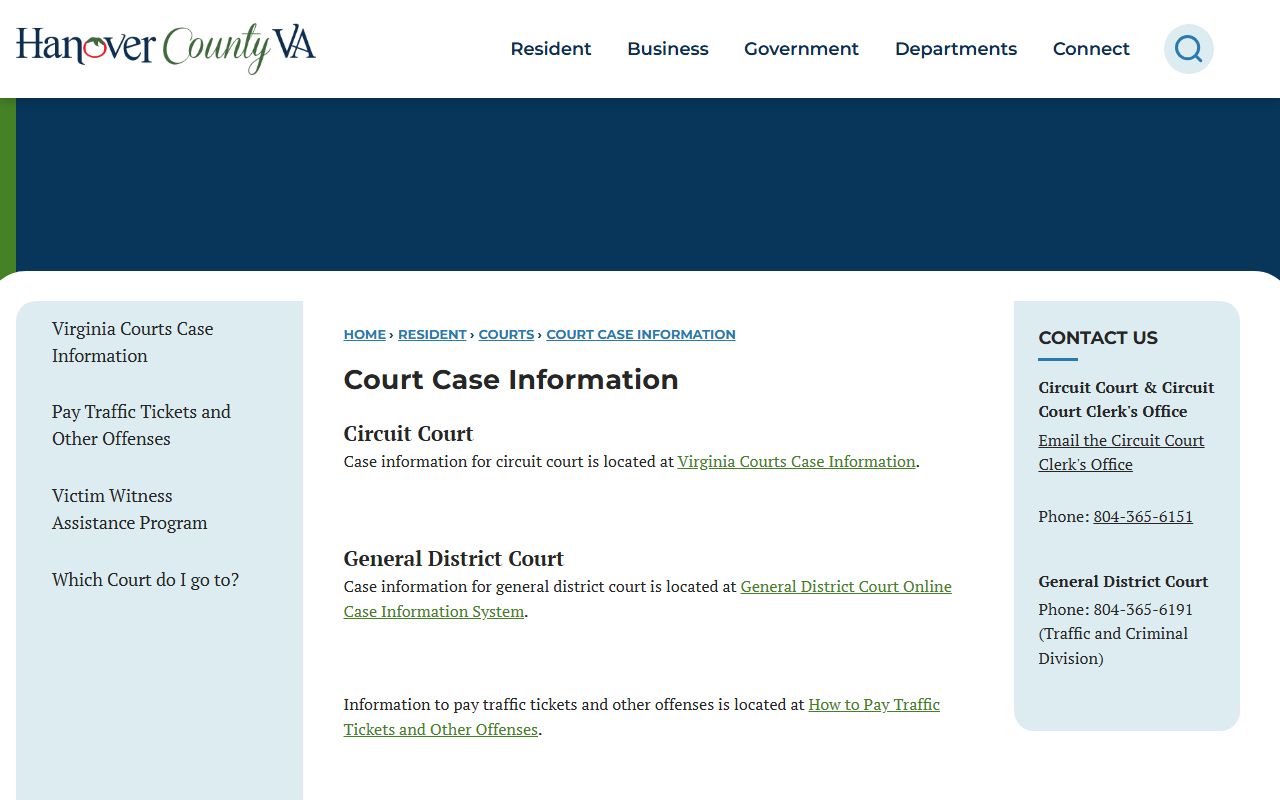
The county page matters because it points a Hanover arrest search toward the correct state case systems instead of treating the jail roster as the formal charge record.
- Start with the booking date and name from the jail record if the person is still in custody.
- Search Hanover General District Court by defendant name for new misdemeanor, traffic, warrant, capias, or preliminary felony matters.
- Search Hanover Circuit Court for felony indictments, appeals, and final felony dispositions.
- Use a case number when available because a name search may return more than one person or case.
- If the online systems do not show the record, call the appropriate clerk before assuming no case exists.
Juvenile and Domestic Relations Court must be treated with more care. Virginia judicial self-help guidance says JDR case information is not available online. For a juvenile matter, a sealed matter, or a domestic case with restricted access, the absence of an online result does not prove that no case exists.
Hanover General District Records
Hanover General District Court is often the first public case-search stop after a jail arrest. The court handles traffic and many criminal matters, and it can show early case entries for warrants, capiases, misdemeanors, and preliminary felony proceedings. The county court information page lists the General District Court traffic and criminal phone line as 804-365-6191, which is the direct local fallback when a new arrest does not yet appear online.
The Virginia General District Court court-selection screen is the search path for selecting Hanover before searching by name, case number, or date.
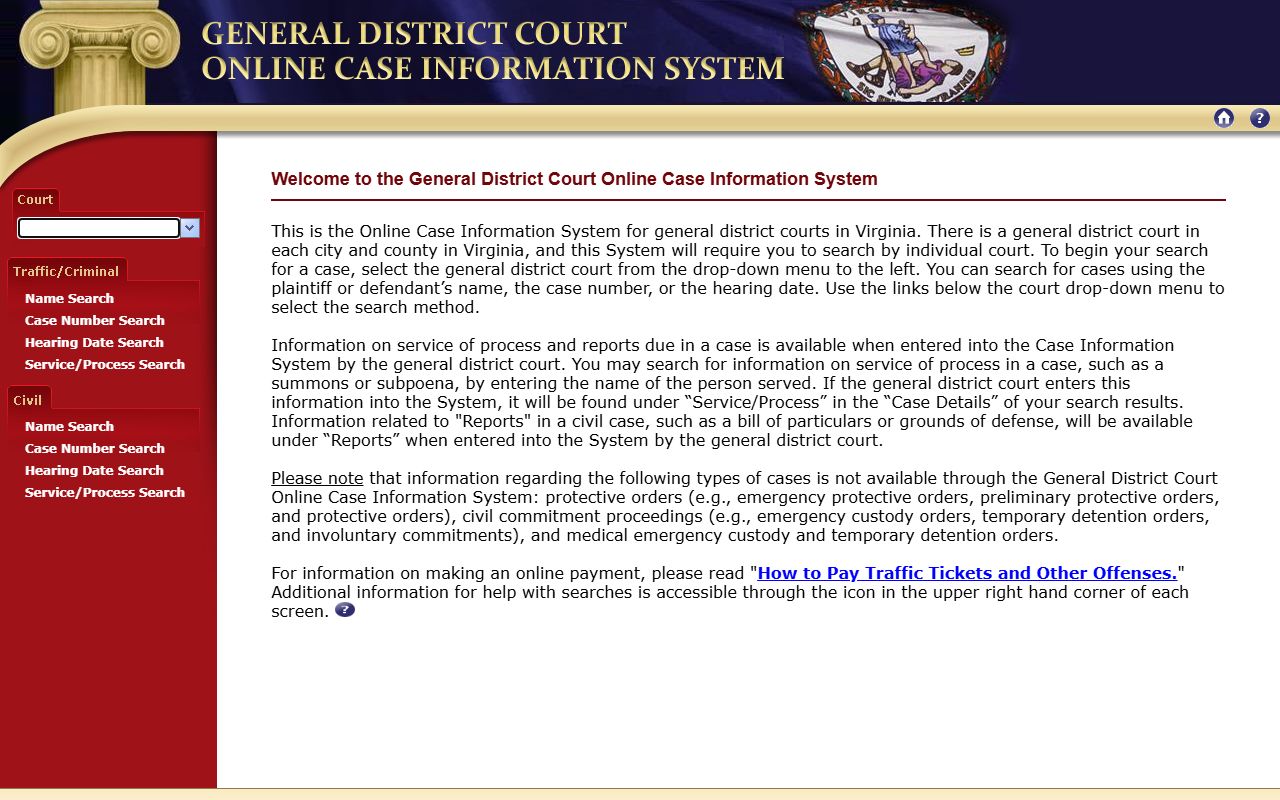
The GDC system is useful for the first layer of court records after arrest because it is keyed to locality and court type, not to the jail's booking list.
| Field Label | Type | Required | Search Notes |
|---|---|---|---|
| Court or locality selection | Dropdown or court link | Yes | Select Hanover General District Court before running the search. |
| Name search | Text | Conditional | Use the defendant name for criminal records after an arrest. |
| Case number | Text | Conditional | Best when the number is known from a summons, warrant, or clerk notice. |
| Hearing date | Date | Conditional | Useful when a first appearance or later hearing date is known. |
| Search or submit | Button | Yes | Runs the selected query for the chosen court. |
Hanover Circuit Court Records
Hanover Circuit Court is the court to check when a felony case moves beyond the first stage, when a grand jury indictment has been returned, or when a misdemeanor appeal has been filed. The county lists the Circuit Court and Circuit Court Clerk phone as 804-365-6151. For older paper files or copy requests, the Circuit Clerk copy page instructs callers to use that number and press 1 for criminal records.
The Virginia Circuit Court Case Information entry page is the statewide route used for participating circuit courts.
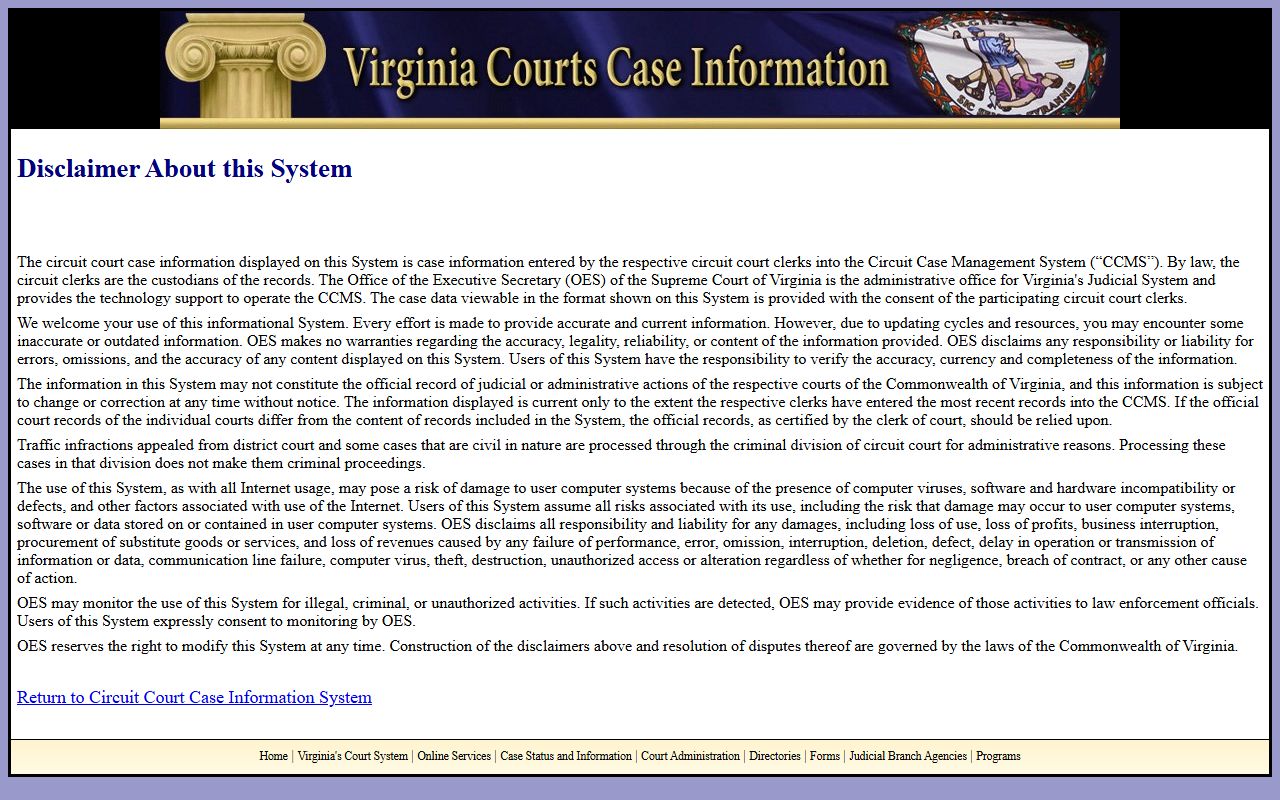
Circuit Court lookup is the key follow-up when a General District result shows a felony certified forward or when the case number changes after indictment.
| Field Label | Type | Required | Search Notes |
|---|---|---|---|
| Locality or court | Dropdown or court link | Yes | Select Hanover Circuit Court where it is listed. |
| Name | Text | Conditional | Search by party or defendant name when the case number is unknown. |
| Case number | Text | Conditional | The strongest option for an exact criminal case lookup. |
| Hearing date | Date | Conditional | Use when the court date is known but the case number is not. |
| Disclaimer acceptance | Button or checkbox | Yes | Virginia court systems commonly require accepting a disclaimer before search. |
Charging Documents After Arrest
A booking charge is the law-enforcement or jail-side label used during intake. It may be close to the final charge, but it is not always the charge that controls the court case. The Commonwealth's Attorney decides how charges proceed in court. In Hanover County, that may mean prosecuting the filed charge, amending it, reducing it, seeking indictment in Circuit Court, or entering a nolle prosequi when the prosecution is not pursued in that posture.
Virginia court records after an arrest may refer to more than one type of charging document. The document type helps explain where the case stands and which court is likely to show the next public action.
| Document | Who Uses It | Common Role | Where It May Lead |
|---|---|---|---|
| Complaint or warrant | Officer, complainant, magistrate, or prosecutor route | Initial accusation that can begin a criminal case after arrest. | Often appears first in General District Court. |
| Information | Commonwealth's Attorney | Formal prosecutor filing used when allowed by procedure and case posture. | Can move a case forward without using the booking label alone. |
| Indictment | Grand jury | Formal felony charge returned for Circuit Court prosecution. | Creates or updates the Circuit Court record. |
The Hanover County Commonwealth's Attorney's Office is the prosecutor's office for local criminal cases, but case status should be verified through the court systems and clerk offices rather than assumed from a jail screen.
Charge Status in Hanover Court
Charge status is the part of a Hanover County court record that tells whether the charge is still active and what happened to it. This field is more useful than a booking label because it follows the case through court action. A charge may be pending at first appearance, changed by the prosecutor, reduced by agreement, dismissed by the court, resolved by plea, or sent to another court level.
| Status | Plain Meaning | Why It Matters |
|---|---|---|
| Pending | The case has not reached a final disposition. | Bond, hearings, and future court dates may still control release or custody. |
| Amended or reduced | The charge changed from the original booking or filed charge. | The court record may no longer match the jail intake label. |
| Dismissed | The charge ended in that court without a conviction on that count. | Dismissal is not the same as expungement or deletion from every record. |
| Nolle prosequi | The prosecutor chose not to pursue that charge in that posture. | The entry should be read with the rest of the case history. |
| Convicted | The court entered a finding or plea of guilt. | Sentencing, appeal rights, and VADOC transfer issues may follow. |
Virginia's law-enforcement records statute, Code of Virginia 2.2-3706, also treats adult arrestee identity and charge status as part of the public-records framework, subject to exemptions. That does not turn every law-enforcement file into a court record. The originating office still controls the official copy.
Bond After Hanover Jail Arrest
Bond is reviewed early in the process, often before the public fully understands which court record to search. Research from Pamunkey describes video arraignments for inmates who do not need to be physically present in court. During arraignment, the judge reviews the facts and determines whether the person is eligible for bond. The local magistrate number listed by Hanover County is 804-365-6206, but bond status can also require the jail, court, or clerk depending on timing.
| Bond Outcome | How It Works | Common Record Clue |
|---|---|---|
| Personal recognizance | Release is based on a written promise to appear and obey conditions. | The case remains pending even though the person is out of jail. |
| Unsecured bond | A bond amount is set, but money is not paid up front unless terms are violated. | The court may show conditions and a next hearing. |
| Secured cash or surety | Money or a licensed surety is required before release. | Call the jail or court route to confirm current type and holds. |
| No bond | The court or magistrate does not authorize release at that stage. | The roster may still show custody while the case moves forward. |
| Hold or detainer | Another agency or jurisdiction blocks release even if local bond is addressed. | Check court records, jail records, VADOC, USMS, or ICE as applicable. |
Official sources reviewed did not publish a Pamunkey-specific public table for bond payment hours or accepted payment methods. Confirm bond type, current holds, and release conditions before arranging payment.
Warrants and Court Records
A warrant or capias can be the reason an arrest happens, and it can become visible through court records after the person is booked. Hanover Sheriff publishes a Most Wanted page for selected wanted people, but no complete official public warrant-search database was located in the research. The Most Wanted page is a public notice channel, not a full list of every active warrant.
For warrant questions, use the court systems for cases tied to warrants or capiases, the sheriff's non-emergency number for routing, and the magistrate for initial warrant and commitment issues. Pamunkey's annual report also notes that fingerprints sent to Virginia State Police can return warrant notifications quickly during booking. That means a person may be held on a warrant discovered at intake even if the initial arrest seemed unrelated.
The Hanover Sheriff Most Wanted page provides one official public warrant channel and lists contact routes for tips or law-enforcement follow-up.
- Arrest warrant
- An order authorizing arrest based on a criminal accusation.
- Bench warrant or capias
- A court order often tied to failure to appear, probation violation, or failure to obey a court order.
- Detainer
- A hold or notice from another agency that may keep the person in custody after local bond is addressed.
- Remand
- A court order sending the person back to custody.
Charges Compared With Convictions
A Hanover County arrest and charge do not mean the person was convicted. A charge is an accusation or formal filing. A conviction is the result of a guilty plea, trial finding, or other final adjudication of guilt. Court records after a jail arrest should be read by case stage, not by the most serious word in the booking entry.
| Point of Comparison | Charge | Conviction |
|---|---|---|
| Case stage | Accusation, warrant, complaint, information, or indictment. | Final finding or plea of guilt on a count. |
| Proof level | May begin with probable cause or a formal accusation. | Requires a legal finding, plea, or verdict. |
| Public meaning | Shows what was alleged or filed. | Shows what the court resolved as guilt. |
| Record risk | May be dismissed, amended, reduced, or moved. | May affect sentencing, supervision, appeal, or transfer. |
Sealed and Expunged Records
Dismissal does not automatically erase a Hanover County court record after an arrest. Virginia expungement is a court process for eligible police and court records. Code of Virginia 19.2-392.2 governs the expungement process. Use the court's status entries and the clerk route to confirm what happened before assuming a record is hidden from public view.
| Point of Comparison | Sealed | Expunged |
|---|---|---|
| Public access | Generally hidden or restricted from ordinary public view. | Handled through a court-ordered process for eligible police and court records. |
| How it happens | By law or court order, depending on record type and case status. | Through the Virginia expungement statute and court procedure. |
| Effect on old references | May restrict official access but may not remove every third-party copy. | Does not guarantee all outside websites update or remove old material. |
| Best verification | Check with the clerk or originating agency. | Check the order, clerk record, and agency compliance path. |
Virginia's court systems and the Virginia Judicial System self-help case page distinguish public online case access from records that are confidential or not available online. Juvenile matters are the clearest example for Hanover arrest records because JDR case information is not available through online case search.
Hanover Prosecutor After Arrest
Virginia uses a Commonwealth's Attorney, not a district attorney. In Hanover County, the Commonwealth's Attorney's Office is located at Hanover Courthouse and is the prosecutor's office for local criminal cases. The county directory identifies Mackenzie Babichenko as Commonwealth's Attorney and lists the office phone as 804-365-6185.
The prosecutor's role is central after a jail arrest because the booking charge may not be the final filed charge. The Commonwealth's Attorney may proceed with misdemeanors or felonies, amend charges, reduce charges, seek a grand jury indictment, or decline to prosecute a charge in its current posture. Victims and witnesses may also use victim/witness assistance through the same office, and custody or case notifications can be tracked through Virginia VINE/VINELink when available.
Formal case status still belongs in the court record. Do not treat a prosecutor listing, sheriff notice, or jail roster as a substitute for the General District or Circuit Court case entry.
Restricted Hanover Court Records
Some court records after a jail arrest are public, and some are limited by law, age, case type, or court order. Juvenile matters are the most common example because online JDR case information is not available. Sealed and expunged records also require care because the visible result may differ from what a court clerk or agency can lawfully confirm.
Law-enforcement records and court records should not be blended. Virginia FOIA can support access to adult arrestee identity, charge status, and booking photographs subject to exceptions, but an investigative file, juvenile record, sealed record, or active felony matter may be restricted. Court clerks are the better source for case copies and dispositions. The county FOIA route is more suited to county or sheriff records that are not court files.
Important: Public-record search results may not be used for credit, employment, housing, insurance, or any FCRA-covered screening purpose.